
Brasilia
For more information, contact:
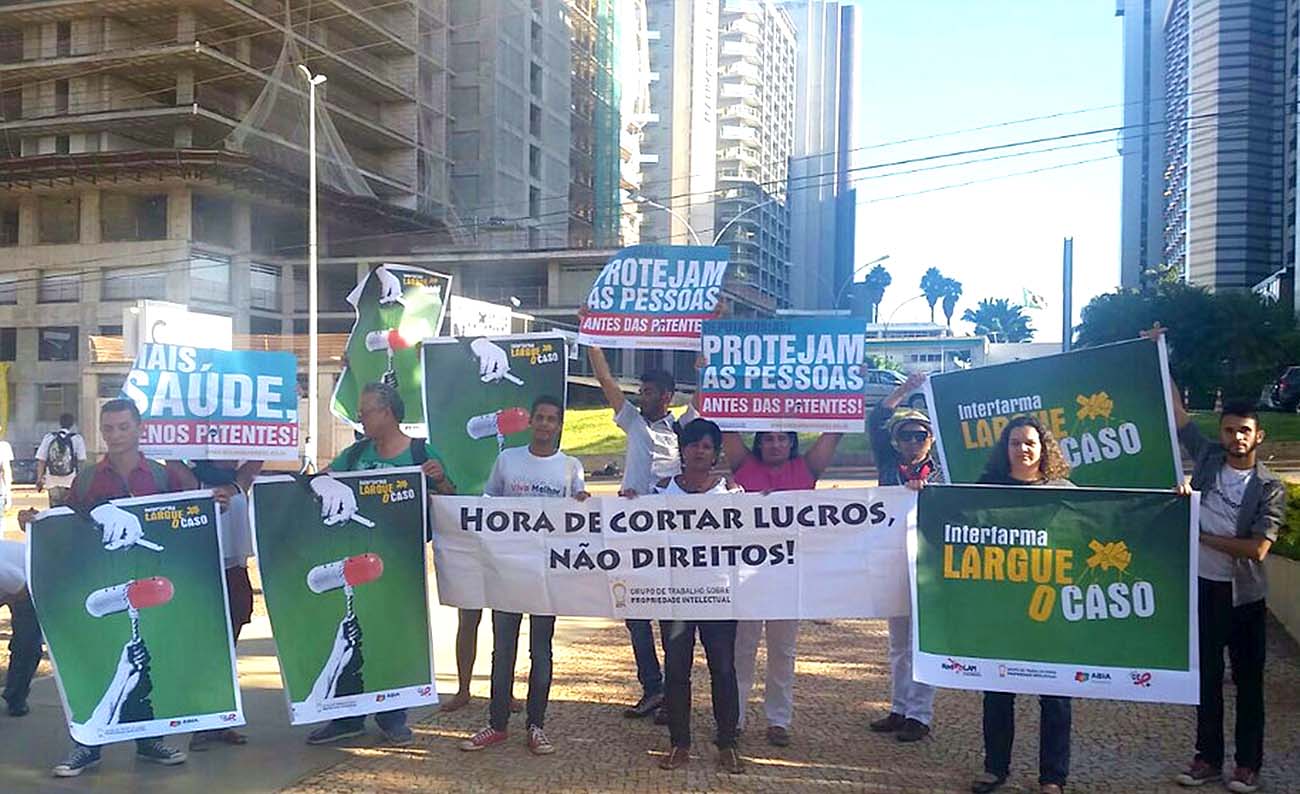
Civil society groups demand that patients get more protection than patents
Organizations denounces human rights violations inside the patent system and demand big pharma to step back on attacks against health protective measures in Brazil and Argentina.
01/04/2016 – Brazil - Civil society groups from Brazil will hold an action on April 1st in Brasília as part of the campaign called “Big pharma: Drop the case”. The campaign demands the abandonment of court cases initiated by associations of transnational pharmaceutical companies in Brazil and Argentina to dismantle local regulations considered important public health safeguards. A global petition can be signed at: redlam.org or deolhonaspatentes.org.br.
The action is part of a Global Action Against Pharma Greed, in which activists across the world are protesting against the greed that blocks access to essential medicines. April Fools’ Day is an appropriate day to highlight both the extortionate price of medicines and the lack of transparency around research and development (R&D) costs. The protest is coordinated by a coalition of over 25 health advocacy groups from 6 continents.
Twenty years after the historic International Aids Conference in Vancouver, when science proved that treatment could stop deaths from Aids, WHO estimates that here is still about 22 million people that lack access to treatment and 1 million people die from Aids every year.
“The patent system is failing people, it favors corporations over public health. It has become an endless machine of monopolies over essential drugs, a machine of violations of the right to health. What we see in Brazil and Argentina is that mechanisms created to put a limit in patent abuses are under attack, so the right to health is even more vulnerable”, says Marcela Vieira, coordinator of the Working Group on Intellectual Property (GTPI) coordinated by the Brazilian Interdisciplinary Aids Association (ABIA).
Lorena Di Giano, Executive Director of Fundación Efecto Positivo (FGEP) and General Coordinator of RedLAM – Red Latinoamericana por el Aceso a Medicamentos, considers that the judicial attacks in Brazil and Argentina need more visibility from international agencies. “These attacks are a severe symptom of a huge crisis we face today. The companies represented by the associations that are doing judicial attacks in Argentina and Brazil, CAEME and Interfarma, are not using the patent system to promote innovation, but instead to block competition and bankrupt public health systems”, says Lorena.
The World Health Organization (WHO) estimates that the deaths of about 18 million people, one third of all human deaths, are caused by medical conditions that could be treated or cured. A primary reason for these avoidable deaths is the lack of access to affordable and effective treatments.
The high prices of medicines are not only a barrier to access in low and middle-income countries, but also in high-income countries. The example that is in the order of the day is the new medicine used to treat hepatitis C, called sofosbuvir (sovaldi®, Gilead). The price is so high that many countries in Europe have not made it available in the public health system, such as the UK. In France, for the first time the price of a drug has led to treatment rationing in the country. Pauline Londeix, co-founder and coordinator of the NGO “Access”, based in France, and one of the panelists of the side event says, “Drug prices are so high that we are close to the point where no country in the world will be able to provide universal access for its population without putting the sustainably of the public health system at stake.”
Brazil and Argentina have both universal public health systems, including free distribution of essential medicines to all. These countries need to ensure sustainable prices for medicines and have created strict standards and procedures for patent examination in the pharmaceutical sector. As result, both countries have successfully blocked several undeserved patents, ensuring generic competition and price reductions for essential drugs.
However, Interfarma and CAEME, associations of transnational pharmaceutical companies filed judicial cases in 2014 and 2015 seeking the annulment of such mechanisms. If courts rule in favor of companies, millions of people in these countries can be left without access to low cost generics. The impact in universal access to medicines programs and in public expenditures can be dramatic.
According to an investigation conducted by the European Commission on the pharmaceutical industry, European governments and consumers paid around three billion Euros in excess between 2000 and 2007 (in relation to 219 drugs) due to abuses in the exercise of patent rights.
“Companies attack our public health safeguards saying that they do it to protect their patents. So who is protecting the people? Human rights are not being enforced to protect people from patent abuses, it’s time to change that before we lose all our right to health achievements”, says Lorena.
The civil society organizations demand that pharmaceutical companies respect the rights of countries to fully use the health protective measures of the WTO TRIPS Agreement and to drop all the judicial cases challenging the implementation of such measures, such as in Argentina and Brazil.
The websites of the GTPI, ABIA, REDLAM and FGEP:
Twitter: