London
For more information, contact:

Why We're Here
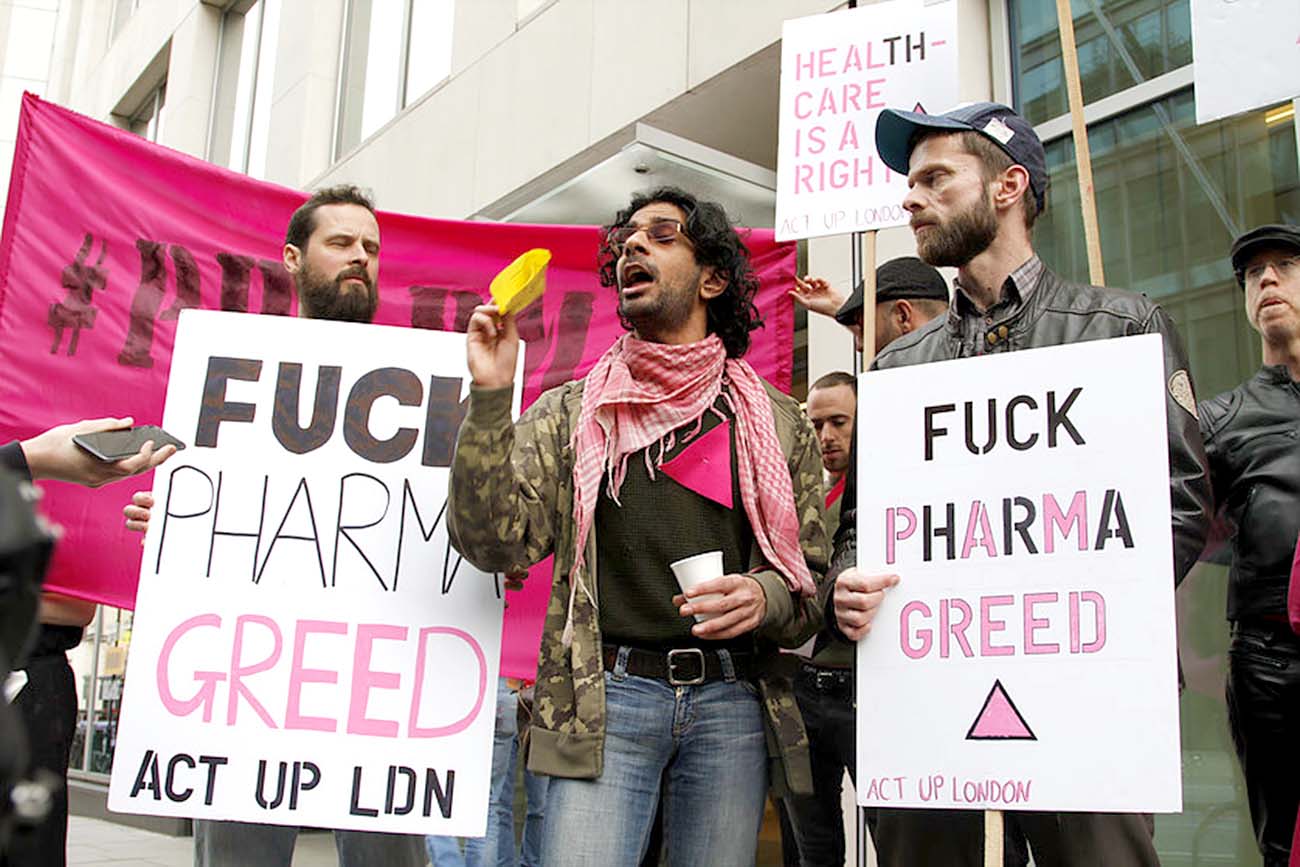
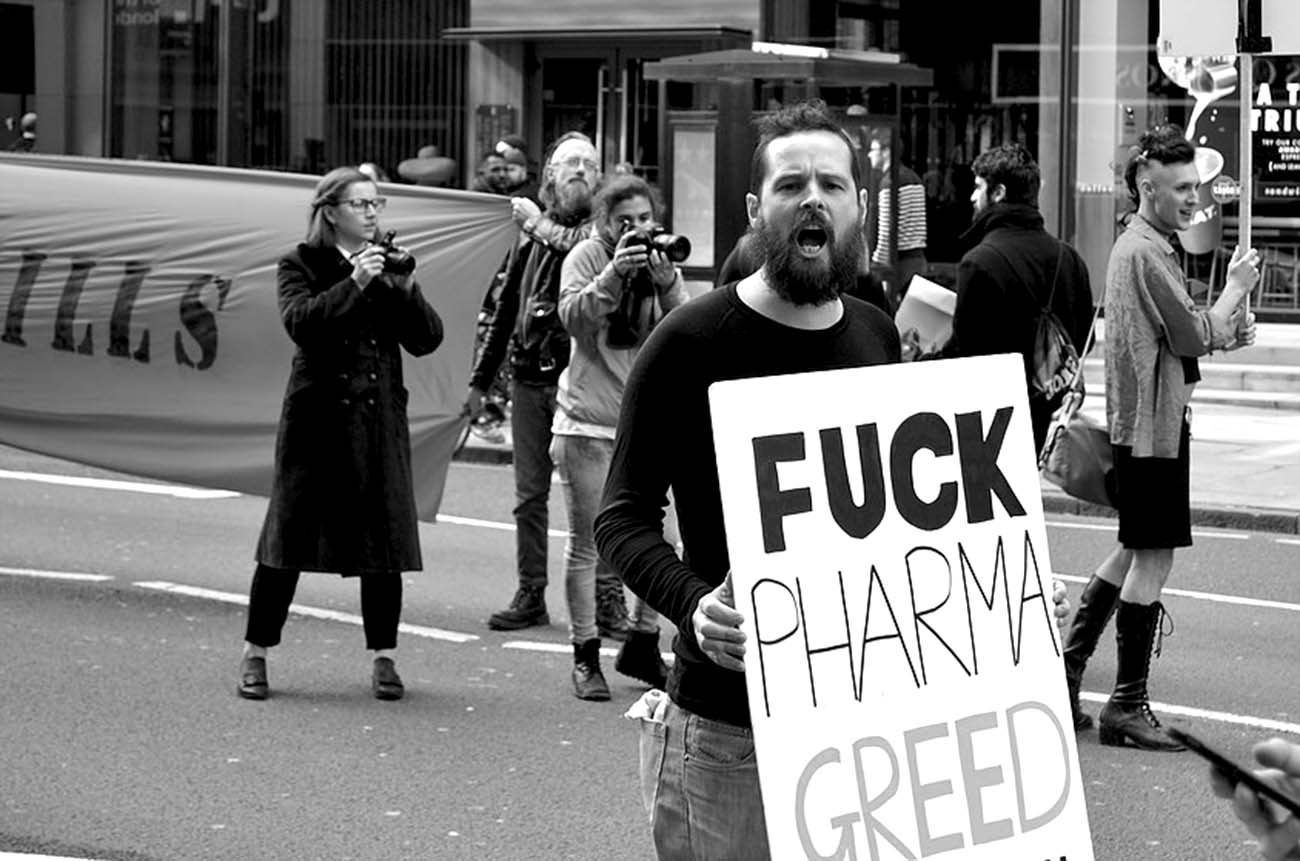
We are here today, on April Fool’s Day, to speak out against the unfairness, unsustainability, absurdity and hypocrisy of the current system for providing access to medication for people in the UK and around the world.
We believe that access to medicines, vaccines and health care should be a basic principle of common dignity that is accessible to everyone.
We believe that people should come before profit, and that the purpose of producing medication is to provide care to those in need, rather than to line the pockets of pharmaceutical company shareholders.
Who We Are
We are a coalition of health advocacy groups, in 11 cities around the world, who feel passionate about ending healthcare inequalities.
What We're Doing
We stand here naked, completely vulnerable, a state in which the current system leaves millions around the world.
We also stand with bareness and honesty, and we demand that drug companies be exposed in the same way.
What We Want
We demand that governments take responsibility for the status quo and take action to change it.
We demand change to the system of developing, producing and distributing medication.
The Full Story
The global human toll. Every year, 10 million people die from diseases for which we already have effective treatments. Two billion people in the world do not have access to essential medicines that should be readily available to them. More than half of all people who live in Asia and Africa cannot access medicines, often due to their high prices, and restrictions on governments simply producing alternatives. As a case in point, the US drug company Pfizer has repeatedly refused to negotiate with Médecins Sans Frontières, which demands a lower price for the pneumonia vaccine. This hugely important vaccine saves children’s lives, but is too expensive for many developing countries to afford. MSF have called on Pfizer to reduce the vaccine price to $5 per child and to disclose the currently secret price that they charge all countries for this vaccine. Pfizer refused.
The NHS held to ransom. At any given time, about half of all people in the UK are on prescription medication. 90% of these prescriptions are for ‘branded’ medication, the bill for which is a painful £5.8 billion pounds. These branded drugs are patented, which means that the rights to production lie exclusively with privately owned companies. The NHS is not allowed to produce these drugs itself or source ‘generic’ - i.e. non-branded - versions from other suppliers. Instead, The NHS is obliged to pay the exorbitant prices set by an oligarchy of pharmaceutical giants.
Why are prices so high? Because these companies are privately owned and share one motive - to maximise shareholder profit. Pharmaceutical executives are not only in the market to make it rich themselves, they are also obliged to make their companies as profitable as possible in order to attract shareholder investment. To do so, they wildly exaggerate drug prices and routinely increase them by arbitrary amounts. On January of this year Pfizer increased prices on more than 100 of its drugs, some by as much as 20%. This means that taxpayers’ money goes straight to the pockets of pharmaceutical company owners and shareholders, whose primary interest is not public health.
What about the costs of Research & Development? Medicines are researched and developed by biopharmaceutical companies in tandem with governments, regulatory bodies, universities and scientists. Most basic product research is carried out by smaller companies (often publicly supported) and academic institutions, then sold to larger companies. R&D itself accounts for a fraction of a pharmaceutical company’s budget.
What about production? Prices do not reflect the costs of production either. For example, a full course of most Hepatitis C drugs cost $60 to $135 to manufacture, and yet these drugs are sold for thousands times more. Pharmaceutical companies routinely and systematically inflate production estimates in order to maximise profit.
How is this scenario even possible? Because the pharmaceutical industry is an economic heavyweight, and economic heavyweights can make their voices heard in political arenas. The pharmaceutical lobby has huge sway, using its power to make regulations, laws and policies that suit its own profit-driven interest, not those of people in need of care. Globally, Pfizer has been very successful in encouraging politicians to threaten trade sanctions against poor countries producing or importing cheap ‘generic’ drugs, and the company pushed for a strict patent law with the World Trade Organisation.
In the UK, the Association of the British Pharmaceutical Industry (ABPI) is the trade association for about a hundred companies producing prescription medicines. Its members manufacture and supply more than 90% of the medicines prescribed through the NHS. The ABPI prides itself on being the leading body in representing the industry view to governments and decision-makers, and aims at shaping and directing legislation affecting the industry.
What’s the alternative? The current system makes no sense. Taxpayers’ money serves to prop up a market that financially benefits an elite few whilst denying access to those most in need. Governments, health care institutions, and patients are forced to deal with public health being a product that is bought and sold. In 2014 Pfizer made $4.4 billion from vaccine sales, whilst, despite the efforts of Médecins Sans Frontières, the poorest, most at-risk children around the world were left without vaccines. This situation is unacceptable. We believe that health is a question of common dignity and not a commodity, and we invite you to join us in bringing about change.
We demand
> A system that puts people before profit, whereby the aim of drug manufacturing is to help protect people’s health as part of wider public health initiatives
> An end to drug patenting, and the free production of medicines where they are needed
> Alternative financing for Research & Development in order to ensure that it serves the public interest
> A binding global Research & Development treaty that expands real access to medication and patient care for everyone